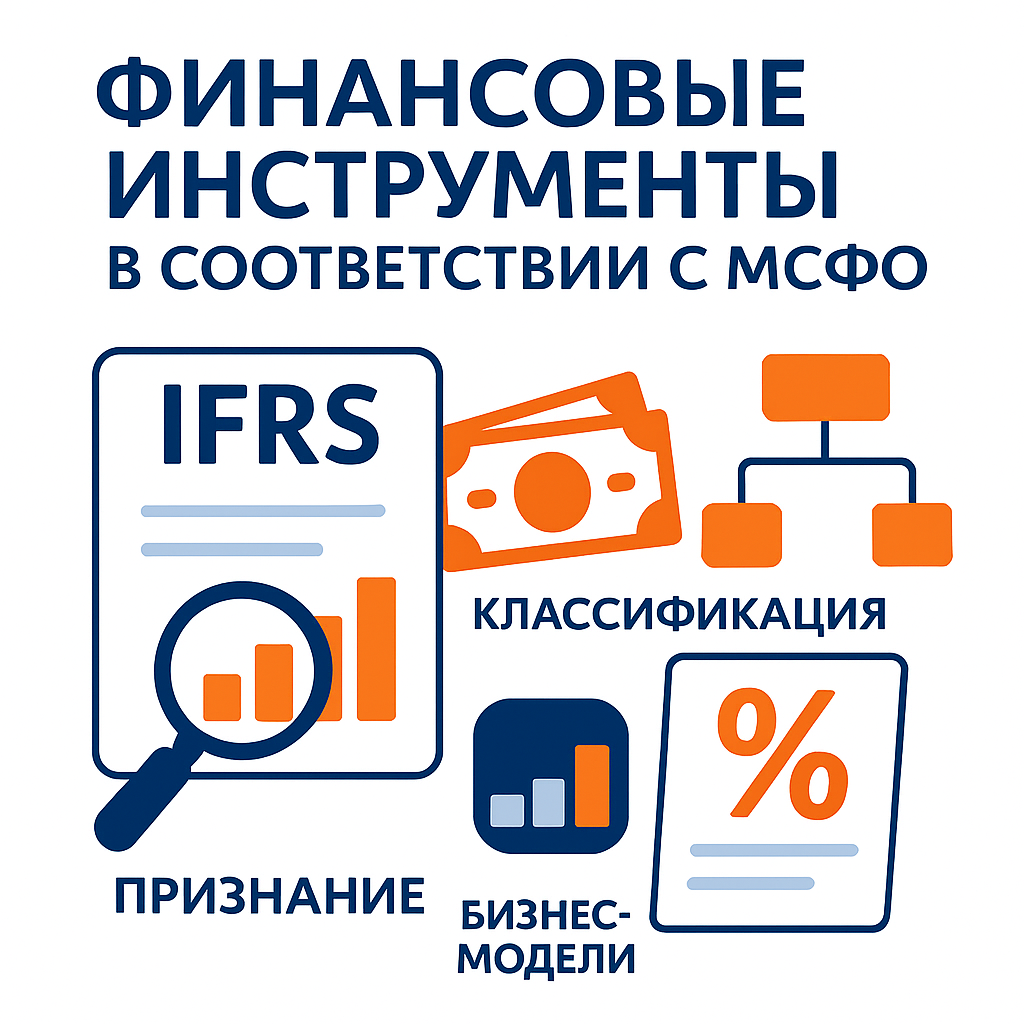
Course description:
International Financial Reporting Standards (IFRS) set specific requirements for the recognition, classification and accounting of financial instruments. This is one of the most complex and at the same time most important areas of the standards, especially for banks, financial institutions and companies with investment activity.
The course is designed for specialists who need not only to understand the theory of IFRS 9, but also to apply it in real financial statements. We look in detail at how to determine the business model, how the classification of financial assets depends on it, how the SPPI test (“solely payments of principal and interest”) works and what consequences its result has.
A separate emphasis is placed on accounting at amortised cost and at fair value through profit or loss or through other comprehensive income. Participants will learn how to calculate the effective interest rate (EIR), which cash flows it applies to and how it affects the recognition of interest income and expense.
We will also cover accounting for loans to legal entities and individuals, provisioning, accounting for guarantees and letters of credit, modifications of instruments and transactions at off-market rates. Special attention is paid to Stage 3 assets, POCI, and disclosures and correct preparation of the financial statements.
All the material is accompanied by examples, calculations and real cases, which helps not only to remember the structure of the standards, but to apply them effectively at work.
Target audience:
Financial analysts, accountants, IFRS specialists, methodologists, auditors, and finance and treasury staff of banks, insurance and investment companies.
Course programme:
Academic hours: 10 (CPD = 8)
Document: State-recognised certificate of training
International Financial Reporting Standards (IFRS) set specific requirements for the recognition, classification and accounting of financial instruments. This is one of the most complex and at the same time most important areas of the standards, especially for banks, financial institutions and companies with investment activity.
The course is designed for specialists who need not only to understand the theory of IFRS 9, but also to apply it in real financial statements. We look in detail at how to determine the business model, how the classification of financial assets depends on it, how the SPPI test (“solely payments of principal and interest”) works and what consequences its result has.
A separate emphasis is placed on accounting at amortised cost and at fair value through profit or loss or through other comprehensive income. Participants will learn how to calculate the effective interest rate (EIR), which cash flows it applies to and how it affects the recognition of interest income and expense.
We will also cover accounting for loans to legal entities and individuals, provisioning, accounting for guarantees and letters of credit, modifications of instruments and transactions at off-market rates. Special attention is paid to Stage 3 assets, POCI, and disclosures and correct preparation of the financial statements.
All the material is accompanied by examples, calculations and real cases, which helps not only to remember the structure of the standards, but to apply them effectively at work.
Target audience:
Financial analysts, accountants, IFRS specialists, methodologists, auditors, and finance and treasury staff of banks, insurance and investment companies.
Course programme:
- Differences between IFRS and local GAAP in accounting for financial instruments.
- Determining business models by asset portfolio.
- Applying the SPPI criterion and its impact on accounting.
- Asset classification: amortised cost, FVTPL, FVOCI.
- The effective interest rate: calculation, application, specifics.
- Accounting for loans to businesses and individuals.
- Accounting for guarantees, letters of credit and expected credit loss provisions.
- Modification of financial instruments and accounting at off-market rates.
- Stage 3 and POCI financial instruments: approaches to recognition and measurement.
- Presenting interest and fee income and expense in the financial statements.
Academic hours: 10 (CPD = 8)
Document: State-recognised certificate of training