Course description:
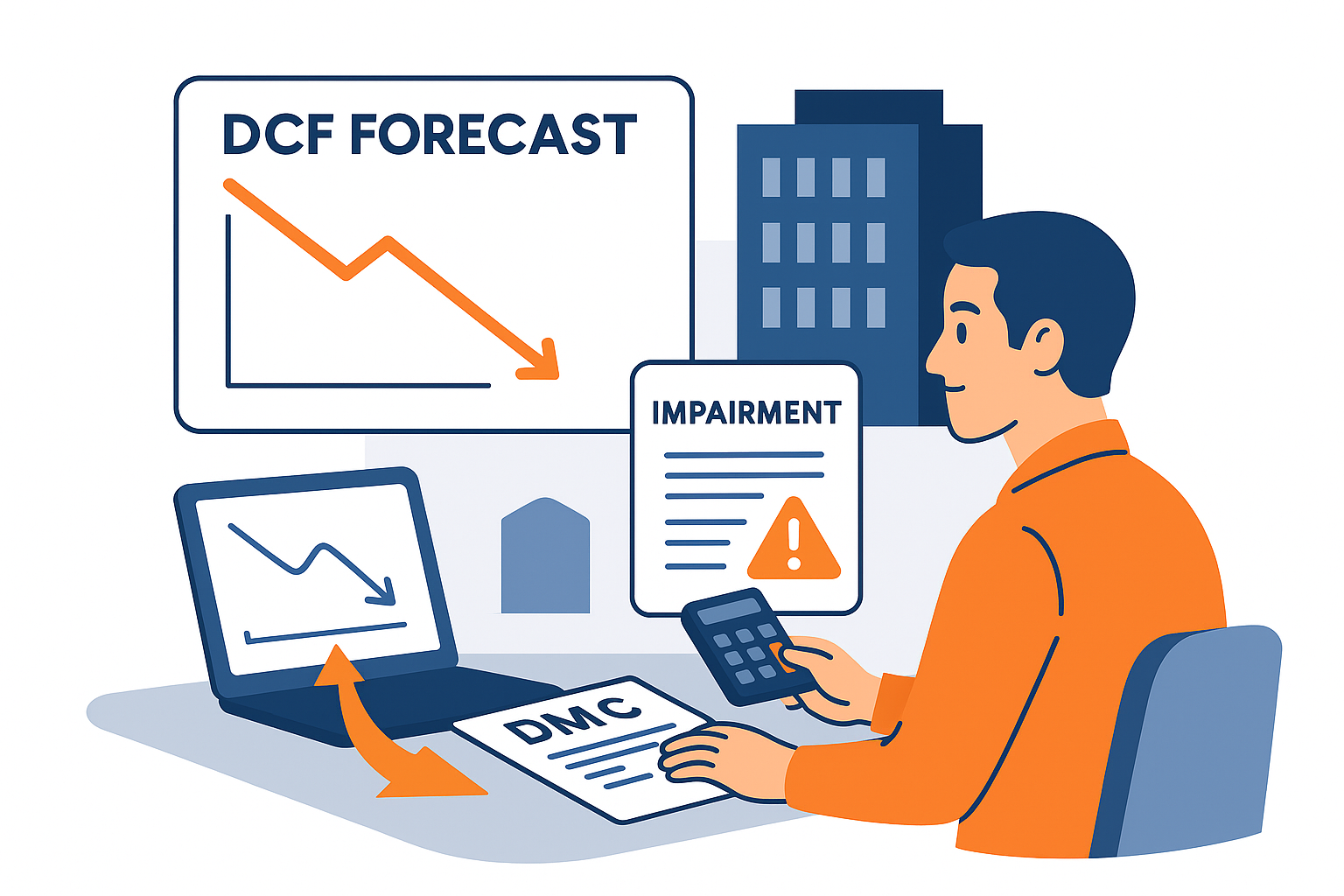
IAS 36 requires companies, including banks, to assess every year whether their assets are impaired. This is especially relevant amid high volatility, deteriorating macroeconomic factors and stress events in the economy. However, “fair value less costs of disposal” is not the only method. It is “value in use” that becomes the key approach for most organisations.
This course is designed for methodologists, accountants and analysts responsible for preparing financial models for impairment testing. We will look at how to build a sound model of future cash flows for cash-generating units (CGUs), which assumptions can be relied on, how to derive the discount rate (WACC) and which elements affect the calculation — from the CGU level to the forecast horizon.
Particular attention is paid to integrating risk factors into the model: how to reflect uncertainty, interest rate volatility, pressure on fee income and the cost of risk. Participants will learn to distinguish an accounting estimate from a management model and understand how the test result affects the bank’s financial statements, capital and strategic decisions.
This course is not only about calculation technique, but also about a mature approach to business resilience: impairment is not just an accounting loss but a trigger for rethinking the operating model.
Target audience:
Methodologists, IFRS specialists, finance professionals, risk managers, analysts, auditors and finance department staff.
Course programme:
IAS 36 requires companies, including banks, to assess every year whether their assets are impaired. This is especially relevant amid high volatility, deteriorating macroeconomic factors and stress events in the economy. However, “fair value less costs of disposal” is not the only method. It is “value in use” that becomes the key approach for most organisations.
This course is designed for methodologists, accountants and analysts responsible for preparing financial models for impairment testing. We will look at how to build a sound model of future cash flows for cash-generating units (CGUs), which assumptions can be relied on, how to derive the discount rate (WACC) and which elements affect the calculation — from the CGU level to the forecast horizon.
Particular attention is paid to integrating risk factors into the model: how to reflect uncertainty, interest rate volatility, pressure on fee income and the cost of risk. Participants will learn to distinguish an accounting estimate from a management model and understand how the test result affects the bank’s financial statements, capital and strategic decisions.
This course is not only about calculation technique, but also about a mature approach to business resilience: impairment is not just an accounting loss but a trigger for rethinking the operating model.
Target audience:
Methodologists, IFRS specialists, finance professionals, risk managers, analysts, auditors and finance department staff.
Course programme:
- Overview of IAS 36 requirements and typical items tested.
- Building the CGU cash flow model: structure, horizons, macro and KPI assumptions.
- CGUs: identifying units, grouping assets and the links between them.
- Measuring value in use: not everything is determined by the market.
- Calculating the discount rate (WACC): structure, beta, risk premium.
- Approaches to determining terminal value.
- Comparison with the fair value approach: where the boundary of applicability lies.
- Recognising and recording an impairment loss; reversible and irreversible impairment.
- Disclosures: what is important to show in the financial statements.
- Practical model examples and cases on fine-tuning CGU models.
Academic hours: 5 (CPD = 4)
Document: State-recognised certificate of training
Document: State-recognised certificate of training