Course description:
IFRS 9 requires companies to take a clear and well-founded approach to classifying and accounting for financial instruments. For banks, insurers and other financial institutions this is not just an element of reporting, but the core of the entire accounting and risk management process.
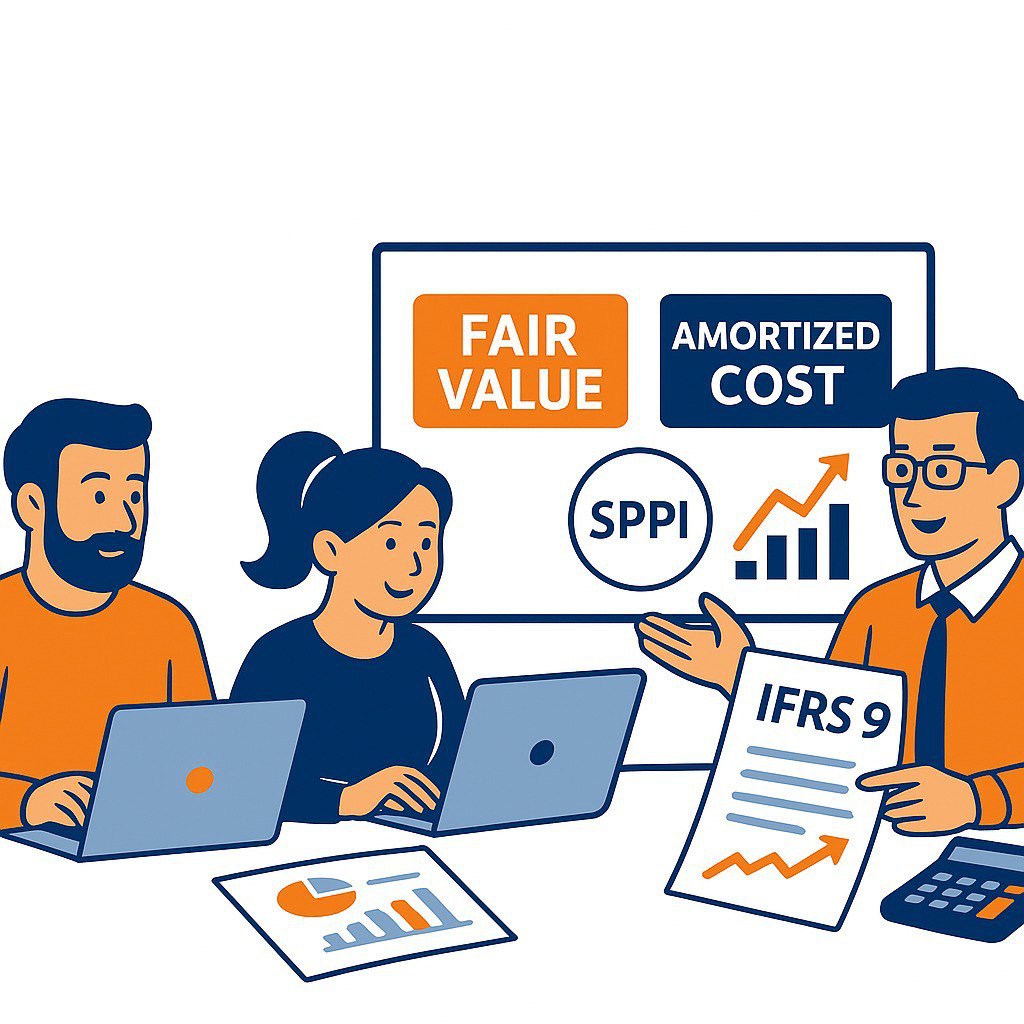
In this course we will look at how to determine the classification of assets on initial recognition, depending on the business model and the results of the SPPI test. You will learn when amortised cost, fair value through other comprehensive income (FVOCI) and fair value through profit or loss (FVTPL) apply, and what consequences each approach has for reporting and provisioning.
Separate attention is paid to the modification and derecognition of financial assets, which is especially relevant for restructurings, extensions and distressed debt. We will also look in detail at the effective interest rate (EIR) — how to calculate it, apply it and reflect it in income.
We also cover aspects of ECL: how to reflect the risks for each class of assets depending on the stage (1, 2, 3), how to model losses and how to remeasure. The programme includes practical examples, mistakes in application and recommendations on presentation in the financial statements.
Target audience:
Accountants, auditors, IFRS specialists, and staff of lending, risk management and methodology units in banks, leasing and microfinance organisations.
Course programme:
IFRS 9 requires companies to take a clear and well-founded approach to classifying and accounting for financial instruments. For banks, insurers and other financial institutions this is not just an element of reporting, but the core of the entire accounting and risk management process.
In this course we will look at how to determine the classification of assets on initial recognition, depending on the business model and the results of the SPPI test. You will learn when amortised cost, fair value through other comprehensive income (FVOCI) and fair value through profit or loss (FVTPL) apply, and what consequences each approach has for reporting and provisioning.
Separate attention is paid to the modification and derecognition of financial assets, which is especially relevant for restructurings, extensions and distressed debt. We will also look in detail at the effective interest rate (EIR) — how to calculate it, apply it and reflect it in income.
We also cover aspects of ECL: how to reflect the risks for each class of assets depending on the stage (1, 2, 3), how to model losses and how to remeasure. The programme includes practical examples, mistakes in application and recommendations on presentation in the financial statements.
Target audience:
Accountants, auditors, IFRS specialists, and staff of lending, risk management and methodology units in banks, leasing and microfinance organisations.
Course programme:
- Classification of financial instruments depending on the business model.
- The SPPI test: essence, examples, typical mistakes.
- Accounting at amortised cost and fair value (FVTPL, FVOCI).
- Recognition, modification and derecognition of assets.
- The effective interest rate (EIR): calculation and application.
- Applying the expected credit loss (ECL) model depending on the stage.
- Accounting for restructured and impaired assets.
- Disclosures: reporting requirements.
- Review of practical cases and preparation for audit.
Academic hours: 10 (CPD = 8)
Document: State-recognised certificate of training
Document: State-recognised certificate of training