Course description:
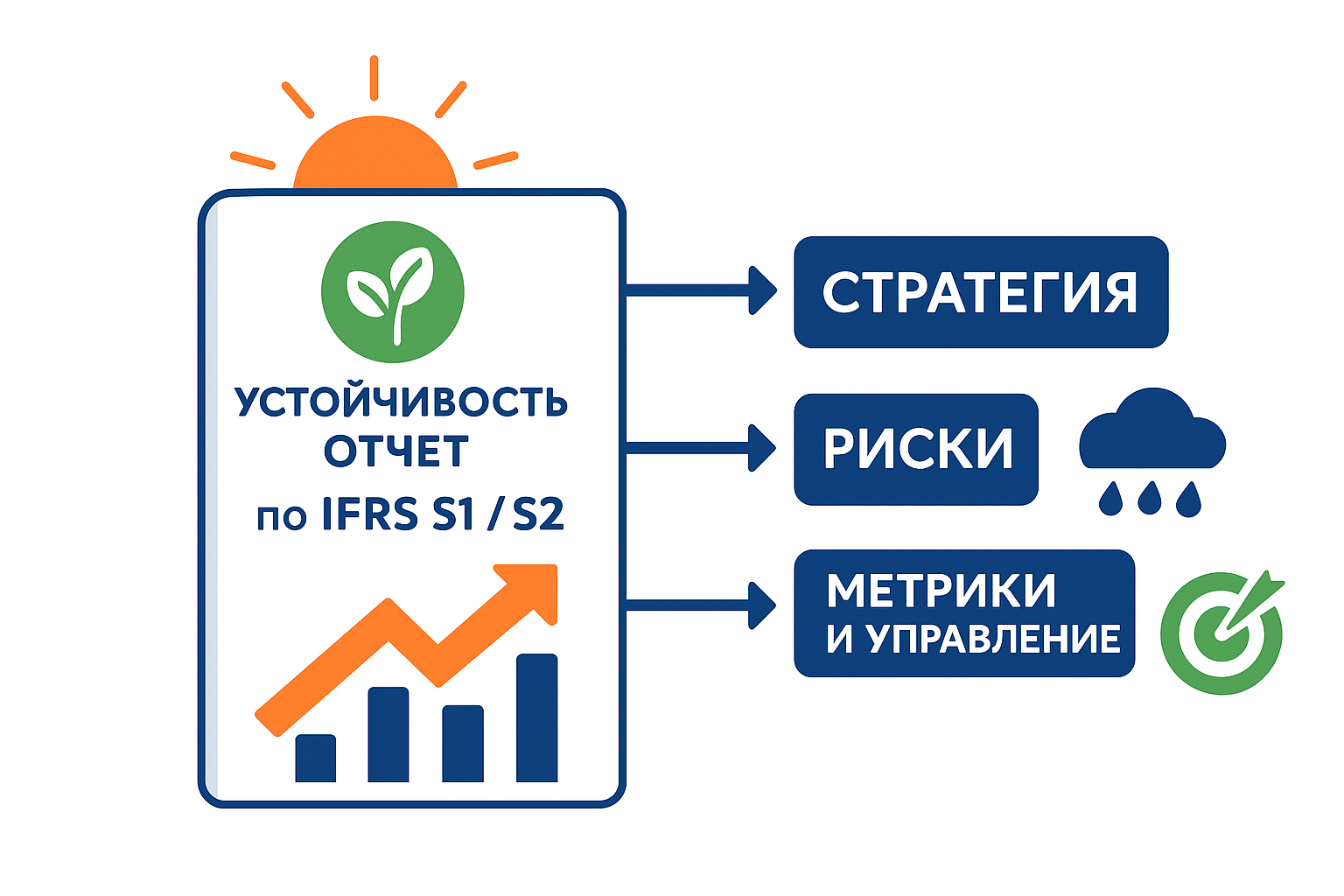
With the arrival of IFRS S1 and S2, sustainability has become a financial category. These two new ISSB standards are not just an extension of IFRS, but a new logic for disclosing risks, strategies, metrics and governance in sustainability and climate transition.
The course is designed for those who need not just to understand the requirements of the standards, but to learn to prepare the information, collect data, set up processes and work with the business on an ongoing basis.
We will look in detail at:
Participants will understand how to build disclosures into strategy, risk management, planning and internal control processes.
A separate focus is managed implementation: how to avoid overload, not to “hang” ESG on a single specialist and turn the requirements into a managed, repeatable process.
The course is based on best practice in preparing disclosures in the EU, ISSB recommendations and examples of large companies from industries where disclosure is already mandatory (banks, finance, manufacturing, retail). There is a block on implementation strategy — a step-by-step plan, responsibility matrix, risk map, preparation calendar and internal data sources.
Target audience:
CFOs, methodologists, sustainability specialists, internal controllers, corporate secretaries, ESG coordinators, risk managers, auditors and members of sustainability committees.
Course programme:
With the arrival of IFRS S1 and S2, sustainability has become a financial category. These two new ISSB standards are not just an extension of IFRS, but a new logic for disclosing risks, strategies, metrics and governance in sustainability and climate transition.
The course is designed for those who need not just to understand the requirements of the standards, but to learn to prepare the information, collect data, set up processes and work with the business on an ongoing basis.
We will look in detail at:
- what exactly IFRS S1 and S2 require to be disclosed,
- how ESG and financial risks are connected,
- which calculations and assumptions are needed for climate risks,
- how to organise an “information-generating machine” in the company — without chaos or panic.
Participants will understand how to build disclosures into strategy, risk management, planning and internal control processes.
A separate focus is managed implementation: how to avoid overload, not to “hang” ESG on a single specialist and turn the requirements into a managed, repeatable process.
The course is based on best practice in preparing disclosures in the EU, ISSB recommendations and examples of large companies from industries where disclosure is already mandatory (banks, finance, manufacturing, retail). There is a block on implementation strategy — a step-by-step plan, responsibility matrix, risk map, preparation calendar and internal data sources.
Target audience:
CFOs, methodologists, sustainability specialists, internal controllers, corporate secretaries, ESG coordinators, risk managers, auditors and members of sustainability committees.
Course programme:
- What IFRS S1 and S2 are: the logic of the standards and their link with IFRS and ESG.
- The connectivity approach: how financial statements and non-financial risks become a single whole.
- Mandatory disclosure elements: governance, strategy, risks, metrics and targets.
- IFRS S1: general sustainability requirements and the approach to integrating information.
- IFRS S2: climate risks and opportunities, climate scenarios, Scope 1–2–3.
- Calculation and methodology issues: where to get the data, how to calculate, which models to use.
- Internal sources of information: how to build an ESG data flow within the company.
- The annual ESG calendar: who, what, when and in what format.
- Responsibility and roles: finance, risk, strategy, sustainability.
- Cases and disclosure examples: European banks, corporations, practice since 2024.
Academic hours: 5 (CPD = 4)
Format: online / offline / blended
Document: State-recognised certificate of training
Format: online / offline / blended
Document: State-recognised certificate of training